beynon.ai
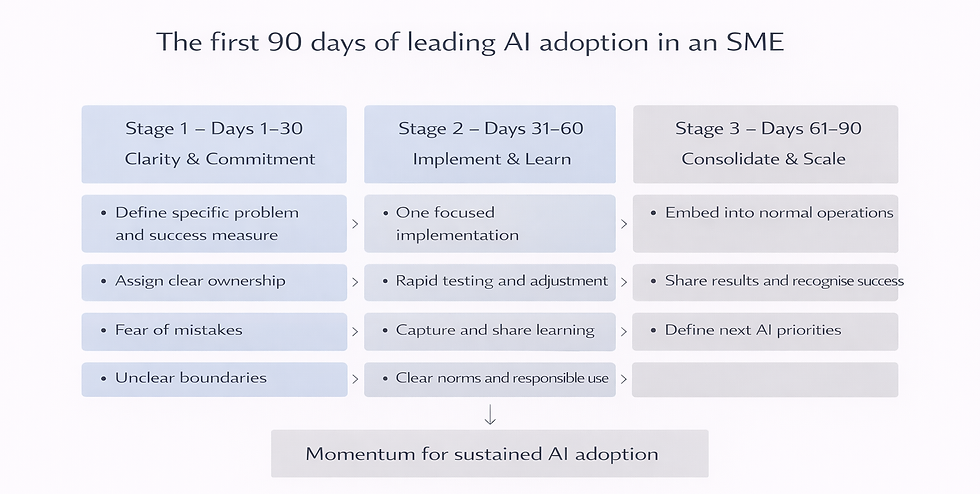
The first three months of AI adoption set the pattern for everything that follows. Get this period right and you build momentum that carries the work forward. Get it wrong and you create patterns of delay, confusion and resistance that are hard to reverse.
Most SME leaders underestimate how much leadership attention the first 90 days requires. They treat AI adoption as something they can delegate and check in on occasionally. What they discover is that without sustained leadership involvement early on, projects drift or stall and the opportunity to establish good patterns is lost.
This matters because the first 90 days isn't about implementing comprehensive AI across the business. It's about establishing clarity, building confidence and proving that AI can deliver value in your specific context. What happens in this period determines whether AI becomes part of how you operate or becomes another failed initiative people remember cynically.
What the first 90 days should accomplish
The purpose of the first 90 days isn't to transform the business. It's to establish foundations that make sustained adoption possible. By the end of this period you should have achieved several specific things.
First is clarity about where you're starting and why. Not a comprehensive AI strategy but a clear view of which specific problem you're solving first and what success looks like. This clarity needs to be widely understood, not just held by the CEO or a project lead.
Second is one completed small win. Something implemented, tested and delivering observable value. Not a pilot that's nearly finished or a proof of concept that's promising. Something actually working that demonstrates AI can deliver practical benefits in your business.
Third is learning captured and shared. The first 90 days generates significant learning about what works in your context and what doesn't. That learning needs to be documented and spread beyond whoever discovered it so the whole organisation can benefit.
Fourth is momentum established. People believe AI is genuinely happening, not just being considered. There's a plan for what comes next and people understand their role in it. The initiative has enough velocity that it continues beyond the initial enthusiasm.
Fifth is governance basics in place. Clear norms about acceptable AI use, obvious boundaries around risk and someone responsible for ensuring standards are maintained. This doesn't need to be elaborate but it needs to exist.
These outcomes are achievable in 90 days for an SME. They don't require massive investment or technical expertise. But they require focused attention and disciplined execution. The businesses that achieve them have CEOs who treat the first 90 days as a priority rather than as something happening in the background.
[Diagram suggestion: 90-day roadmap showing key milestones and decision points]
Days 1-30: Establishing clarity and commitment
The first month is about creating clarity and demonstrating commitment. This is when patterns of leadership attention get established and when employees form views about whether AI is genuinely important or just another initiative that will fade.
The most important task in the first week is defining the specific problem you're solving and the measure of success. Not vague aspirations but concrete outcomes. "Reduce time spent on invoice processing by 50%" or "improve customer response time from 4 hours to 1 hour". Something specific enough that you'll know within weeks whether it's working.
This definition process should involve the people who'll be directly affected. If you're solving a customer service problem, customer service staff need to be part of defining what success means. This involvement creates buy-in and ensures you're solving a problem that actually matters rather than one that sounds strategic but doesn't align with operational reality.
The second task is identifying clear ownership. By the end of week two someone should be unambiguously responsible for making AI adoption happen. Not as a side responsibility but as a primary focus for the next 90 days. This person needs authority to make decisions, resources to act and protection from having their time consumed by other demands.
The third task is early communication with everyone who'll be affected. Not formal announcements but genuine conversations. What's being tried, why it matters and what it means for them. This communication should explicitly address job security and skills concerns rather than hoping these topics won't come up.
By the end of month one you should have: a specific problem defined with clear success measures, an owner identified and empowered, affected employees informed and involved, and initial tool or approach selected. You don't need perfect choices but you need clear direction.
For more on how to make these initial choices, see "Where to start with AI when you don't have a tech team".
Days 31-60: Implementing and learning
The second month is about implementation, rapid learning and adjustment. This is when you discover what actually works in your context rather than what theory suggested would work.
The focus should be on one small, well-defined implementation. Not multiple pilots or broad exploration but one thing taken through to completion. The smaller and more focused the better because you want to finish something within this period rather than starting many things that will take longer.
What this looks like depends on your specific situation but it typically involves: selecting a specific tool or approach, testing it with a small group, discovering what breaks or doesn't work as expected, adjusting based on those discoveries and documenting what you learn.
The learning matters more than perfect execution. When something doesn't work, that's valuable information. When people struggle with a tool, understanding why improves future implementations. When data quality blocks progress, knowing that prevents making the same mistake elsewhere.
This period should include regular brief check-ins with the person leading the work. Not micromanagement but sustained attention that provides decisions when needed and clears obstacles. The CEO's ongoing involvement signals this remains a priority even when other urgent matters appear.
By mid-month you should have early results visible. Not necessarily complete success but observable progress. Customer response times improving slightly. Invoice processing that's faster even if not yet at target. Something tangible that demonstrates AI is actually helping.
The second half of month two is about consolidating what's working and fixing what isn't. If the tool or approach needs adjustment, make those changes now. If people need additional support or training, provide it. If success measures need refinement, adjust them based on what you've learned.
By the end of month two you should have: one AI application actually implemented and delivering some value, clear understanding of what worked and what didn't, documented learning that can inform future projects, and visible early results that build confidence.
Days 61-90: Consolidating and planning next steps
The third month is about consolidating what's been achieved, spreading learning and establishing what happens next. This is when you transition from the first project to sustained adoption.
The first task is ensuring the initial implementation is properly embedded. It shouldn't require constant attention from leadership or the project owner. People should be using it as part of normal work. Support mechanisms should be in place for questions and problems. It's graduated from project to operation.
The second task is capturing and sharing learning. What worked, what didn't and what that means for future AI adoption. This doesn't need to be a formal report. It can be a brief document, a team meeting or a presentation. What matters is that knowledge spreads beyond those directly involved so the whole organisation benefits.
The third task is recognising the success visibly. Acknowledge the people who made it happen, show the results achieved and explain what it means for the business. This recognition serves multiple purposes. It rewards effort, demonstrates that leadership pays attention to results and creates momentum for future work.
The fourth task is defining what's next. Not a comprehensive multi-year roadmap but a clear view of the next one or two things to tackle. Based on what you learned in the first project, where else could AI deliver similar value? What other problems are worth solving? Who should own that work?
This planning should be informed by the lessons from the first 90 days. If data quality was a problem, next projects should account for that. If employee concerns weren't addressed well, improve that for next time. If the tool chosen had limitations, factor that into future selections.
By the end of month three you should have: first implementation stable and delivering value, learning documented and shared, success recognised publicly, next steps defined and owned, and governance basics established. The business should have shifted from considering AI to actively using it.
[Diagram suggestion: transition from project to sustained adoption showing key checkpoints]
Common pitfalls in the first 90 days
Several predictable mistakes undermine the first 90 days of AI adoption. Awareness of these patterns helps avoid them.
The first pitfall is trying to do too much. Leaders get excited about AI's potential and launch multiple initiatives simultaneously. The result is that nothing gets finished properly and the learning that comes from completion never happens. Focus on one thing done well beats many things started poorly.
The second pitfall is insufficient leadership attention. The CEO delegates AI adoption and then gets consumed by other priorities. People interpret this as AI not really mattering despite what was said. They adjust their engagement accordingly and momentum disappears.
The third pitfall is perfectionism. Leaders want to be certain they're making the right choices before proceeding. They research endlessly, debate options and wait for complete information. By the time they decide, 90 days has passed and nothing has been implemented. Good enough decisions made quickly beat perfect decisions made slowly.
The fourth pitfall is ignoring the people dimension. Leaders focus entirely on tools and processes while neglecting employee concerns, communication and involvement. This creates resistance that surfaces later and slows everything down. Attending to people issues early prevents problems that are harder to fix later.
The fifth pitfall is lack of clear measures. Projects proceed without defining success clearly. By day 90 nobody's sure whether things worked or not. Without measurement, learning is limited and it's hard to maintain momentum because success isn't obvious.
For more on why projects fail and how to avoid it, see "Why most AI projects fail in small and medium businesses".
How to maintain momentum beyond 90 days
The end of 90 days isn't the end of AI adoption. It's the end of the beginning. What's been established in this period needs to carry forward into sustained adoption.
Maintaining momentum requires several things. First is continuing the pattern of focused small projects rather than trying to transform everything simultaneously. The discipline that served you in the first 90 days continues to serve you afterward.
Second is maintaining leadership attention. The CEO doesn't need to be as intensively involved as in the first 90 days but involvement can't disappear completely. Regular check-ins, continued interest in results and visible recognition of progress maintain the signal that AI matters.
Third is spreading ownership beyond one person. The initial owner might continue leading but others need to develop capability and take responsibility for AI in their areas. This distribution prevents the work from being dependent on one individual and builds broader organisational capacity.
Fourth is continuing to learn and share. As the business tries new AI applications, the learning process continues. What worked, what didn't and what that teaches you about your organisation. This learning gets captured and spread so capability compounds.
Fifth is evolving governance as understanding deepens. The basic governance established in the first 90 days needs to develop as AI use expands and as new risks or opportunities emerge. Governance shouldn't be static but it should be deliberate.
The businesses that maintain momentum are the ones that recognise the first 90 days as foundation-building not completion. They use what they've established to tackle progressively more significant problems while maintaining the discipline and focus that made the first 90 days successful.
Practical takeaways for SME leaders
-
Treat the first 90 days as requiring sustained leadership attention, not as something you can delegate and check on occasionally
-
Focus on completing one small implementation rather than starting multiple initiatives that won't finish
-
Define specific success measures at the start so you'll know whether things are working
-
Identify clear ownership with someone treating AI adoption as their primary focus for this period
-
Involve affected employees early and address concerns about jobs and skills directly
-
Document learning continuously so knowledge spreads beyond whoever discovered it first
-
Recognise success visibly at the end of 90 days to build momentum for what comes next
-
Plan next steps based on what you learned rather than jumping to large implementations
The pattern that successful 90 days establishes
What the first 90 days creates isn't just one AI implementation. It's a pattern for how the business approaches AI adoption. Focus over diffusion. Completion over exploration. Learning over perfection. Leadership involvement over delegation.
That pattern becomes how the business operates as AI adoption expands. The habits established in 90 days shape whether AI becomes embedded in operations or remains a series of disconnected projects that never quite deliver their potential. Get the first 90 days right and everything that follows becomes easier. For broader context on sustained adoption, see "Building an AI culture in a small or medium business"
Author: Sean Beynon Founder of beynon.ai and an experienced marketer helping UK SMEs adopt AI safely and practically, with a focus on leadership, governance and real-world implementation rather than technology theory.