beynon.ai
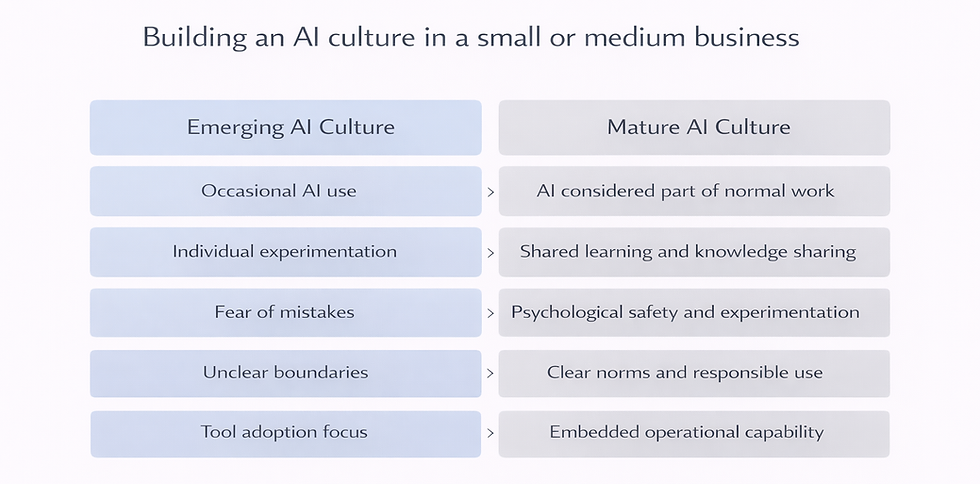
The phrase "AI culture" sounds like something only large technology companies need to worry about. But in SMEs the culture around AI matters just as much, perhaps more, because there are fewer formal systems and processes to guide behaviour. How people actually use AI and whether they see it as helpful or threatening is determined almost entirely by culture.
Most SME leaders don't set out to build an AI culture deliberately. They introduce tools, provide some training and hope people adapt. What they discover is that without deliberate culture-building, AI adoption is patchy and tentative. Some people embrace it, others ignore it and the benefits remain unrealised.
This matters because AI culture isn't something that emerges naturally. It has to be built through consistent leadership behaviour, clear norms and visible reinforcement of desired practices. The businesses that do this well aren't special. They just pay attention to culture as deliberately as they pay attention to tools.
What AI culture actually means in practice
AI culture in an SME doesn't mean everyone becomes an AI expert or that every process involves AI. It means the organisation has shared norms about when and how to use AI, clear expectations about acceptable practice and comfort with experimentation and learning.
In practical terms this shows up in several ways. People naturally consider whether AI could help with a task before defaulting to manual work. They're comfortable trying AI tools and learning from mistakes rather than avoiding them for fear of getting things wrong. They share what they learn with colleagues rather than keeping knowledge to themselves. And they understand the boundaries of acceptable use rather than having to ask permission constantly.
This is different from general innovation culture or technology adoption. AI culture specifically involves comfort with tools that feel semi-intelligent, acceptance that outputs need human verification and judgment about when AI enhances work versus when it creates risk.
The businesses that have strong AI culture don't necessarily use more AI than others. But they use it more consistently, more appropriately and with less friction. The capability is embedded in how people work rather than being a special initiative that some people participate in.
[Diagram suggestion: characteristics of mature AI culture vs emerging AI culture]
The cultural foundations that need to exist first
You can't build AI culture on a poor foundation. If the underlying organisational culture is characterised by fear of mistakes, lack of trust or resistance to change, AI culture won't take root regardless of what you do.
The first foundation is psychological safety. People need to feel they can try things, make mistakes and ask basic questions without being judged or penalised. If your culture punishes failure or treats not knowing as incompetence, people won't experiment with AI. They'll stick with familiar methods where they know they're competent.
The second foundation is knowledge sharing. In businesses where people hoard information or operate in silos, AI knowledge stays isolated with whoever discovered it first. Culture that encourages sharing and collaboration allows AI capability to spread naturally rather than requiring formal training for everything.
The third foundation is comfort with change. If your business has a pattern of failed change initiatives or if employees are cynical about new tools, AI culture will struggle. People need to believe that when the business introduces something new, it's genuine and worth engaging with rather than just this year's management fad.
These foundations take time to build if they're not present. You can't create them purely for AI adoption. But you need to assess whether they exist before expecting AI culture to develop. If they're weak, strengthening them needs to happen alongside AI introduction not after.
For more on creating the broader conditions for AI adoption, see "AI readiness checklist for CEOs: people, data and processes".
Leadership behaviours that shape AI culture
Culture in SMEs flows directly from leadership behaviour. What leaders do matters more than what they say. If you want people to use AI thoughtfully, you need to model that behaviour visibly.
The most important leadership behaviour is actual use. If leaders talk about AI being important but never visibly use AI tools themselves, employees interpret that as lip service. They conclude that AI matters for some people but not everyone. When leaders use AI for their own work and talk about what they're learning, it legitimises experimentation for everyone.
The second critical behaviour is how leaders respond to mistakes. When someone tries AI and gets it wrong, does the leader use it as a teaching moment or as evidence they shouldn't have tried? The response to early mistakes sets the tone for whether people feel safe experimenting or whether they conclude it's safer to avoid AI entirely.
Third is how leaders reinforce AI use. When someone finds a clever AI application or shares what they've learned, does the leader acknowledge it publicly? When meetings happen, does the leader ask how AI might help with whatever is being discussed? These small consistent reinforcements signal that AI is genuinely valued not just officially supported.
Fourth is how leaders handle concerns and questions. Do they treat questions about AI as signs of resistance to be overcome or as legitimate inquiries deserving thoughtful answers? The way leaders engage with skepticism and uncertainty shapes whether people feel comfortable raising concerns or whether they keep doubts to themselves.
The businesses with strong AI culture almost always have leaders who are genuinely curious about AI themselves. Not necessarily expert but willing to learn, try things and admit when they don't know. That curiosity is contagious in ways that mandates never are.
Creating norms around AI use
AI culture requires explicit norms about when to use AI, how to use it responsibly and what constitutes good practice. Without norms, everyone invents their own approach and the result is inconsistency and confusion.
Norms need to cover several areas. First is when AI is appropriate versus when human judgment should prevail. For example, AI might be acceptable for drafting routine emails but not for final decisions on customer complaints. These distinctions need to be clear and consistently applied.
Second is quality standards. What level of review is required for AI outputs? When is it acceptable to use AI-generated content directly versus when does it need human editing or verification? These standards prevent over-reliance on AI while also avoiding the opposite problem of treating all AI output as suspect.
Third is transparency about AI use. Should employees disclose to customers when AI has been involved? Should they tell colleagues when they've used AI for internal work? Different businesses will answer these questions differently but having clear norms prevents everyone making individual judgments.
Fourth is boundaries around data and privacy. What information can be put into AI tools and what can't? How should sensitive customer data be handled? These boundaries need to be explicit because the risks aren't always obvious to people using AI tools.
Creating these norms isn't a one-time exercise. They evolve as the business learns more about AI and as tools become more capable. But having some norms from the start is better than having none and then trying to impose them retroactively.
[Diagram suggestion: AI use framework showing appropriate vs inappropriate applications]
Making learning visible and continuous
AI culture thrives when learning is visible and continuous rather than confined to formal training. In SMEs this means creating channels where people naturally share what they discover and help each other solve problems.
The simplest approach is regular informal sharing sessions. Not elaborate presentations but short show-and-tell meetings where someone demonstrates how they used AI to solve a problem. These sessions do several things. They spread practical knowledge faster than training. They normalise experimentation by showing that everyone is learning. And they create permission to try things because people see others doing it.
Documentation also matters but it needs to be lightweight. Not formal wikis or procedure manuals but shared documents where people note useful prompts, tool comparisons or lessons from mistakes. The format matters less than having somewhere people naturally look when they have a question.
Some businesses create internal champions or AI buddies who colleagues can turn to for help. These aren't formal trainers. They're people who've developed confidence with AI and are willing to support others. Having someone to ask without feeling stupid accelerates learning significantly.
The mistake many businesses make is thinking learning happens through courses and then stops. AI is evolving fast enough that learning needs to be continuous. The businesses that build strong AI culture treat learning as ongoing and normalise not knowing rather than expecting instant expertise.
For more on the support employees need, see "What employees really need from leaders during AI change".
Encouraging appropriate experimentation
Strong AI culture requires that people feel free to experiment with AI applications without requiring permission for every attempt. But this needs boundaries otherwise experimentation creates risk.
The way to square this circle is defining safe experimentation zones. These are areas where people can try AI freely because the risks are low. Internal documents, process improvements, personal productivity tools. Places where mistakes are recoverable and the downside is limited.
Outside those zones, experimentation requires approval or oversight. Customer-facing content, legal documents, financial decisions, sensitive data handling. These areas need controls but the controls shouldn't prevent all experimentation. They just add review steps.
What this looks like in practice is telling people explicitly what they can try without asking and what requires conversation first. "Feel free to use AI for draft emails, meeting summaries or research. But check with your manager before using it for customer-facing content or anything involving personal data." That clarity enables experimentation while managing risk.
The businesses that get this right also celebrate interesting failures. When someone tries AI for something novel and it doesn't work, that's valuable learning. Sharing why it failed and what was learned helps everyone. Treating failure purely as mistake to be avoided kills the experimentation that drives improvement.
Addressing resistance and skepticism constructively
Not everyone will embrace AI culture even with thoughtful leadership. Some people will be skeptical or resistant. How you handle that resistance matters for whether culture develops or stalls.
The first principle is distinguishing legitimate concerns from blanket resistance. Someone who raises questions about data privacy or output quality is helping improve practice. Someone who rejects AI entirely because they don't trust it is resisting change. The first deserves thoughtful response. The second needs different handling.
For legitimate concerns, the response is engagement. Acknowledge the issue, explain how it's being addressed and adjust practice if the concern is valid. This demonstrates that skepticism is acceptable and that concerns are taken seriously. It also improves your actual AI practice by surfacing risks you might have missed.
For blanket resistance, the response is clearer expectations. AI isn't optional if it's genuinely important to how the business operates. People don't need to be enthusiastic but they need to engage with it appropriately. Making this clear while also providing support for those who find change difficult is the balance required.
Some resistance comes from lack of confidence rather than opposition to AI itself. People worry they won't be able to learn it or that they'll look incompetent. For these individuals, targeted support and patience often converts resistance to engagement. Forcing participation without addressing underlying anxiety just hardens resistance.
[Diagram suggestion: responding to concerns flowchart from concern type to appropriate response
Embedding AI in normal operations
AI culture becomes sustainable when AI use is embedded in normal operations rather than being a separate initiative. This means incorporating AI into existing workflows, systems and expectations rather than treating it as additional work.
In practical terms this looks like including AI considerations in standard process reviews. When you're looking at how customer queries are handled, AI capability is part of that discussion not a separate topic. When planning projects, whether AI could help is a standard question not something raised occasionally.
It also means incorporating AI expectations into role descriptions and performance discussions where relevant. If someone's role involves tasks where AI can help, using AI appropriately becomes part of what's expected. Not in a heavy-handed way but as a normal evolution of how work gets done.
Training for new employees includes AI expectations and capabilities from the start rather than AI being introduced as something special. The message is that AI tools are part of how the business works, like any other business system.
The businesses that reach this point usually started with AI as an initiative but deliberately worked to embed it into operations. They stopped treating AI as special and started treating it as normal. That transition is when culture becomes self-sustaining rather than requiring constant leadership attention.
Measuring whether culture is developing
Culture is harder to measure than tool adoption but there are visible indicators that AI culture is taking root in an SME.
The first indicator is unprompted use. People use AI tools to solve problems without being told to. They suggest AI applications without leadership prompting. This shows that AI is becoming default consideration rather than something people remember only when reminded.
The second is knowledge sharing. People naturally share AI tips, interesting use cases or lessons from mistakes. Conversations include AI without it being the main topic. This shows that AI has become normal enough to discuss casually rather than only in formal contexts.
The third is appropriate judgment. People use AI for suitable applications and avoid it for inappropriate ones without requiring supervision. They understand the boundaries and operate within them. This shows that norms have been internalised rather than just known.
The fourth is comfort with learning. People ask questions about AI without embarrassment and admit when they don't know something. They try new applications and share both successes and failures. This shows psychological safety around AI experimentation.
These indicators tell you more about culture health than metrics like how many people have used AI tools or how many processes include AI. Culture is about norms, confidence and shared practice rather than adoption rates.
Practical takeaways for SME leaders
-
Build AI culture through consistent leadership behaviour more than through policies or mandates
-
Ensure psychological safety, knowledge sharing and comfort with change exist before expecting AI culture to develop
-
Model AI use visibly yourself, including sharing what you're learning and where you make mistakes
-
Create explicit norms about when AI use is appropriate, what quality standards apply and how to handle sensitive data
-
Make learning visible and continuous through informal sharing rather than relying only on formal training
-
Define safe experimentation zones where people can try AI freely without requiring permission for every attempt
-
Address skepticism and resistance constructively, distinguishing legitimate concerns from blanket opposition
-
Embed AI into normal operations rather than treating it as a permanent special initiative
Culture as foundation for sustainable adoption
AI culture isn't an outcome of successful AI adoption. It's the foundation that makes adoption sustainable. Without it, AI remains dependent on leadership push and individual enthusiasm. With it, AI use becomes natural and self-reinforcing.
The businesses that build strong AI culture don't do anything particularly sophisticated. They just recognise that culture matters and give it sustained attention. They understand that tools alone don't change how organisations work. Culture does. For context on the broader governance framework that supports healthy AI culture, see "What AI governance actually means for small businesses".
Author: Sean Beynon Founder of beynon.ai and an experienced marketer helping UK SMEs adopt AI safely and practically, with a focus on leadership, governance and real-world implementation rather than technology theory.